True story
A law student in New York wanted 212-867-5309 (yes, Jenny's number). He just asked Verizon for it, and they gave it to him free. He auctioned it on eBay for over $80,000. The lesson is not the money. It is that he asked, when everyone else assumed it was impossible.
DIYvanityNumbers.com · The Number Hunting Guide
Shhhh.
We're hunting numbers.
The spreadsheet I sent is your hunting map. Every working number that spells your word, who carries each one right now, and a single score telling you which ones are sitting quiet, waiting to be claimed. This guide is the part the map can't print: how to read it, which one to stalk, and exactly what to say to bag it.
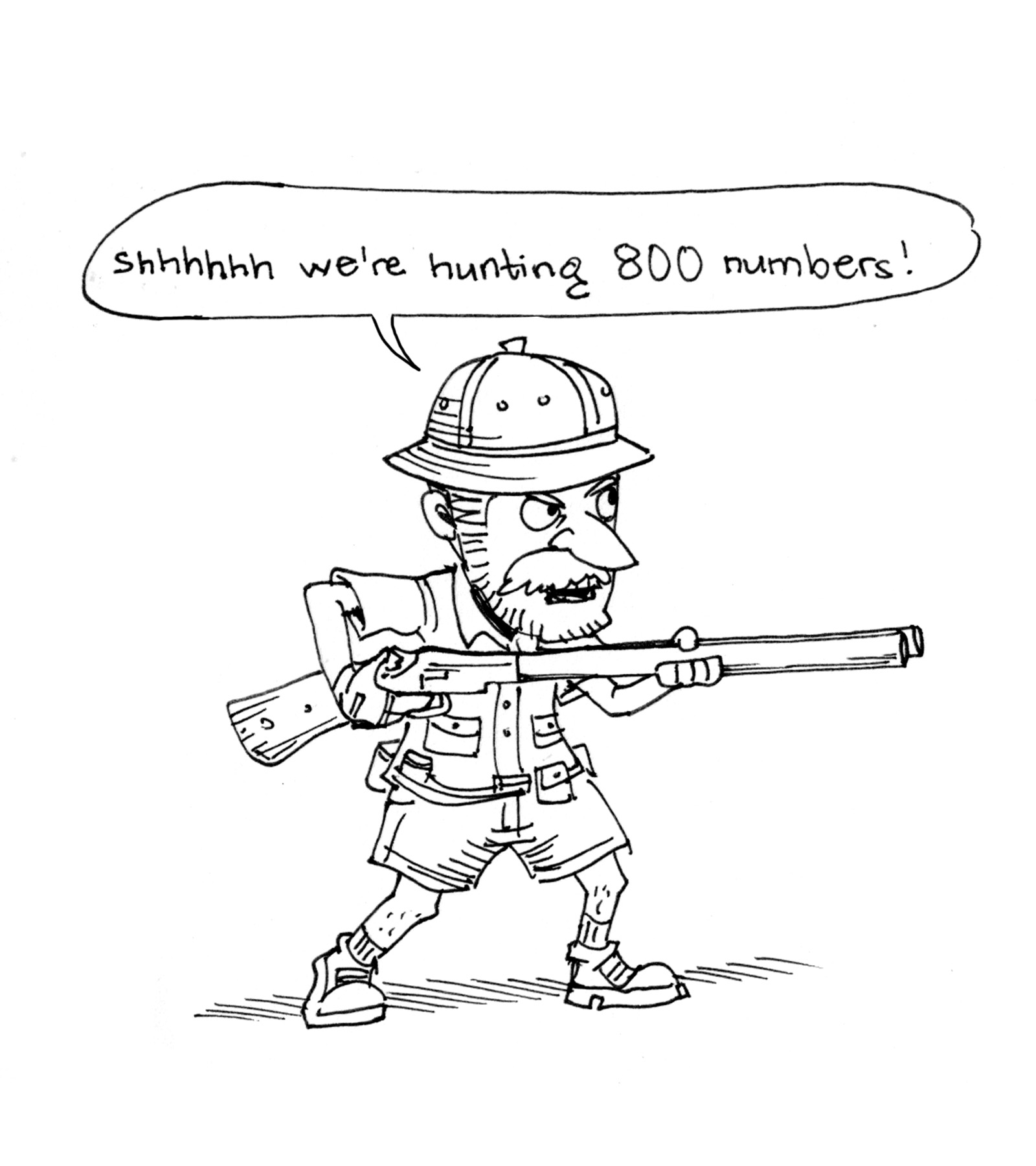
Let me tell you what I am, because it explains this whole thing. I am a bounty hunter for phone numbers that make money. I have done this for 30 years. And the one secret everybody else in this business hides from you is simple: a number the lookup calls "taken" is very often gettable anyway. They just want you to stop there, so they can sell you one of theirs instead. I would rather hand you the pole and the map and teach you to hunt.
Here is the honest deal. You will do a little legwork. In return you can land a number for the cost of a few phone calls instead of the cost of a car. Your phone number is the front door to new customers, and a good one goes up in value the more you use it. Worth a Saturday afternoon.
One promise and one warning, same breath: I can help you get the best possible number, not the perfect one. The perfect one in your head may belong to a dentist in Toledo who will never let go. The best possible one is out there, often hiding in plain sight on your map, and a little persistence lands it.
01Pick the right quarry
The number one reason people go home empty handed is not the phone company. It is that they only want the single hardest number to get, and they quit when they can't have it.

It's natural to think of the most generic words first, and you can check them if you want but don't get hung up on that. Generic = Expensive and/or Impossible for toll free because of their searchability. Sometimes you can get lucky with local numbers because of the way they trickle out and get assigned to random carriers. So you can start with something generic, but don't get so hung up on one generic term that you miss out on all the other options because there are a lot and many are actually even better.
There's no rule that the first business idea you think of is the best, that the first car you drive is the best or the first vacation you take is the best. So don't assume that the first number you thought of is the best. The most obvious things are honestly never the best, no matter how much you think they are before you do your homework.
Never advertise a name you can't rank for.
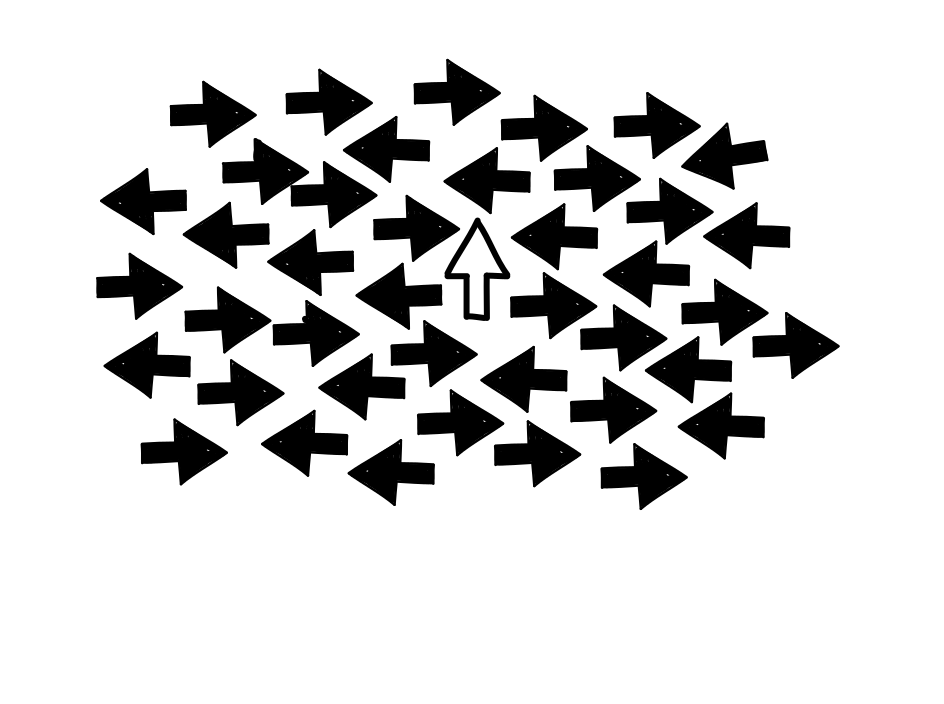
A number that spells the whole industry points at the whole industry, and even your mother thinks that term means the whole industry not your specific business. A number tied to your name, your town, or your specialty is worth more because it makes a stronger connection. So if you don't get your first choice don't give up. There are a lot more options!
- Be relentlessly creative. If you can't think of 50 to 100 versions of your word, you're not trying hard enough yet. The 83rd name you think of is often the best one.
- Don't limit yourself to 7 digits. 8··-LIMO-HELP is far easier to remember than 8··-435-LIMO. A number people remember beats a number that spells the word perfectly.
- Build your selling point in. FAST-CLOSER, QUICK-LOAN, and GREAT-RATE all beat the bare industry term, and they're far more likely to be open.
And widen your map, not just your words. With 10-digit dialing everywhere and long distance basically free, your area code matters less to customers than it used to. Your word is probably sitting open in several of the 300-plus area codes out there. A little flexibility on where is often the whole difference between getting lucky and going home empty handed.

02Read your map (and the Hunt Score)
Open the spreadsheet (the .csv attached in the email). Each row is one real number that spells your word, in one area code. Here is what it's telling you.
| Column | What it means to you |
|---|---|
| Vanity / Number | The number two ways: what it spells (305-PLUMBER) and the digits you dial. |
| Area code / Market | Where it lives, with the city and rough population so you can judge if that area code is worth it. |
| Released | When the phone company initially got this block. Newer is better for you, fresh blocks hold the most unused numbers. |
| Current carrier + phone + website | This is the door you knock on, and I hand you the key. Who holds the number today. On the numbers worth chasing, the carrier's phone number is right there to call; I leave it off the in-use ones so you never waste a dial. Their name links to a full page about that company on NewLocalNumbers.com, every block they hold and how they operate, so you can size them up before you dial. |
| Hunt score | The headline. See below. |
| Status / Result | My plain read of the score, and what my test call found, so you don't have to do the math. |
| Note / Your notes | Anything I flagged, plus a blank column to track your own calls. Work it like a to-do list. |
The Hunt Score is one number from 0 to 100, and low is the good news. A low score means the number is less active, worth chasing. It starts from an independent activity reading. Then, for the promising ones, I place a quiet call myself so you don't have to guess:
- If my call hit a "not in service" recording, I marked it prime (about 10). The line announced it's quiet.
- If someone answered (a person or a real voicemail), I marked it in use (about 85) and crossed it off, even if the data looked open. The call caught a hidden user so you don't waste a call. (I never record or keep anyone's greeting. The only thing I note is "someone answered.")
- If the call didn't settle it (rang out, generic message), the data reading stands.
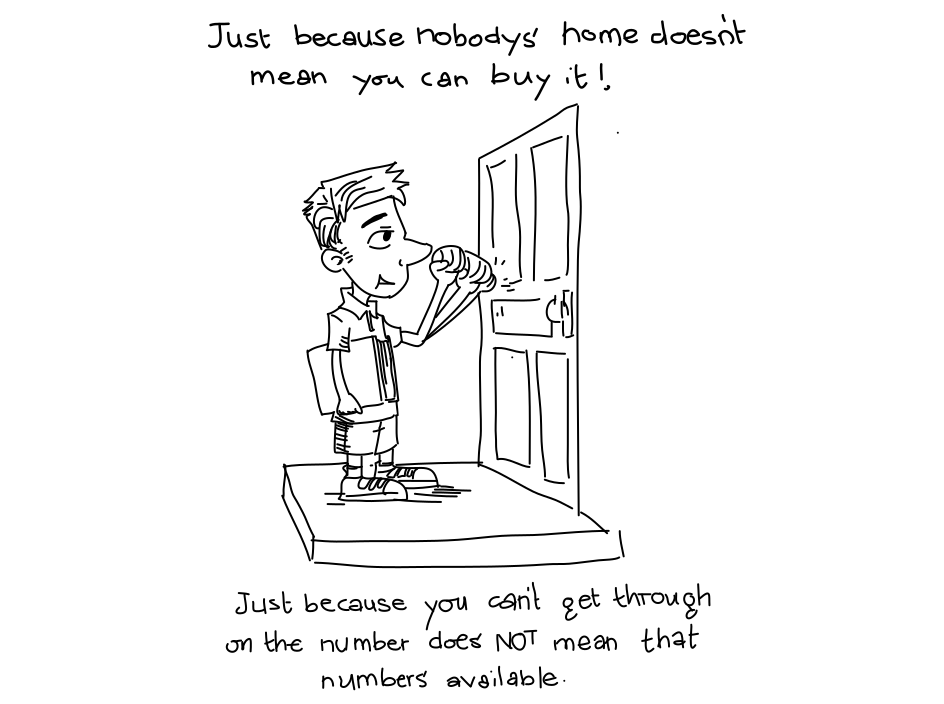
One more truth most people miss: a number that doesn't go through is NOT the same as available, any more than a domain that won't pull up a web page means it's available to register. Plenty of numbers read active in the national database with no real customer behind them anymore, and those quiet ones are exactly what we hunt.
[ Drawing spot ]
Bill's pen-and-ink: a marked-up map with a couple of numbers circled and an X on the quiet one
Bill's pen-and-ink: a marked-up map with a couple of numbers circled and an X on the quiet one
03Start with the easy money shot

Before you do anything else, take the easy shot. Sort your quiet list by the Current carrier column, then look for the carrier you already have an account with, your cell company, your office line.
If your phone is on T-Mobile and you see five plumbing numbers in your area code that look open on T-Mobile, you just found the easy money shot. When you call a company you're already a customer of, half the work is done before you dial. You have an account, a history, a rep who can pull you up in two seconds. You're not a stranger asking a favor, you're a customer asking to add a number that's sitting idle.
Walk in with your five favorites on a carrier you already use. Ask for number one. Maybe you leave with number two. Even if it's not the first choice hopefully you'll leave with a great number, fast.
That is the whole magic of this. We do the homework, the lookups and a couple of phone calls that can turn into a number worth thousands of dollars to your business over its life. And here is the part that still surprises people: when you land one this way, they aren't selling it to you. They're giving it to you.
04It's much easier with a researched list
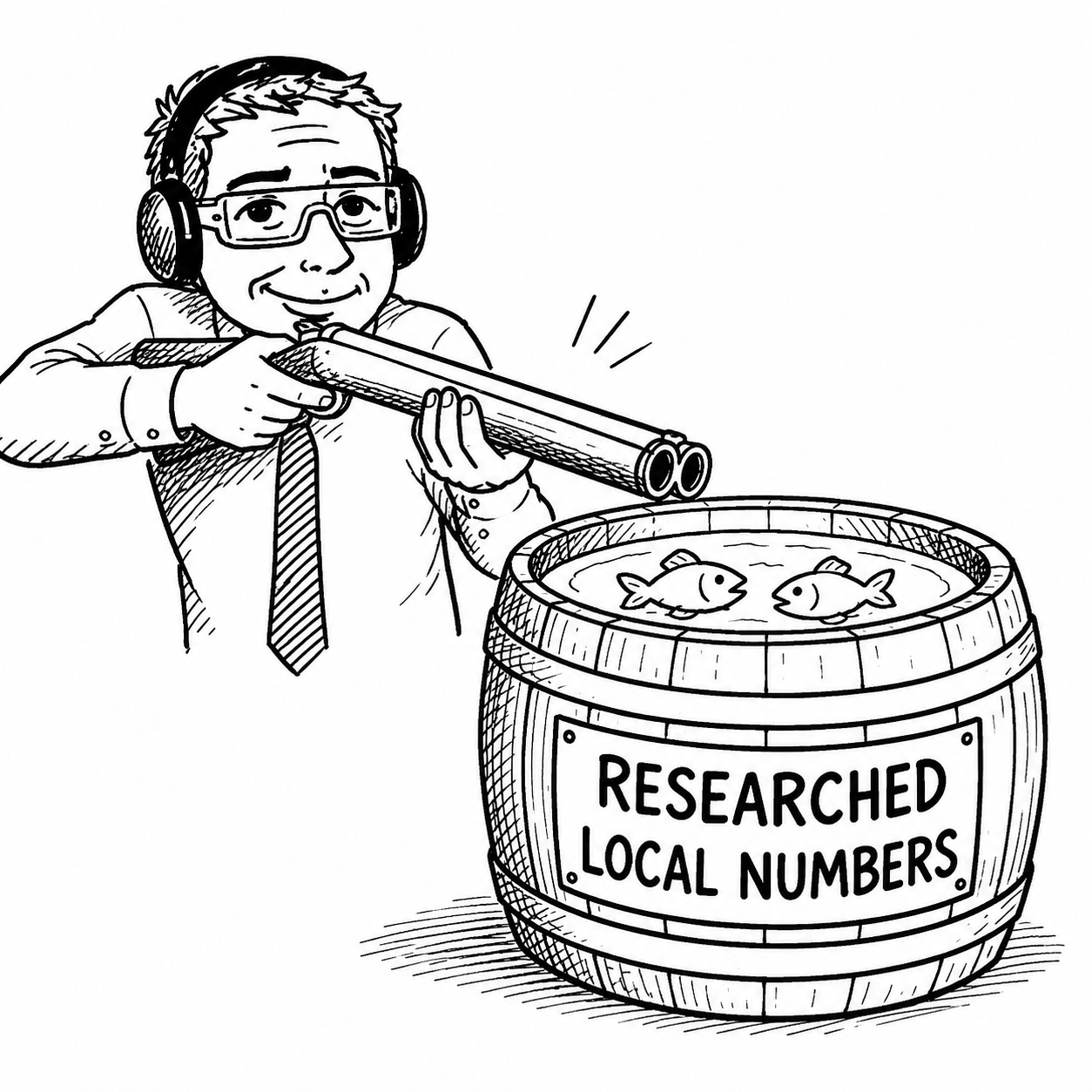
You've got your shortlist. Now you call the carrier in the "Current carrier" column. The golden rule for the whole call: don't accept the first no. A rep saying "that's not possible" usually means that rep doesn't know how. People always say something is impossible when they don't know how to do it. They're not going to tell you they don't know how to do it. They're going to say they can't do it and make it seem like nobody there can do it.
1
Get a backup first. Before you fall in love, pick a solid second and third choice off your map. This part is unpredictable and you probably have a deadline. A good hunter always has more than one shot lined up.
2
Don't talk to sales. You're probably assuming sales has more incentive to get you a good number, but in many phone companies sales are outside agents that have no access to anything internal. Ask for customer service. Front-line sales give out the next number off a list of available numbers. They don't have access to anything else and often have no idea this is even possible.
3
Keep notes, and rotate. Write down the first name, city, department, date and time of every call (that's the "Your notes" column). You can't take a rep's answer at face value, so call back and you'll often get a different, better answer. You probably don't want the same person twice. But if you do reach someone that knows what they're doing, that contact is very valuable.
4
Say it simple and specific. "I'd like a specific number I believe is inactive in my area, 305-758-6237. Can you tell me if it's available to assign, and how I'd get it on my account?" Give them the digits, not the word. They think in digits. If you're already a customer, lead with that.
5
Try the billing desk. Billing is anxious to collect money, so they talk. Ask if you really need the account number on the check because you don't have it handy, and four times out of five they'll give it to you, or at least tell you what city the bill goes to. Little facts like that can add up, and before you know it you have all the information to reactivate a number.
6
Don't ask for information. If you ask for information you'll get shut down instantly, because they all know they aren't supposed to give out customer information. But if they think you know what you're doing, they'll often reveal things trying to help you, without realizing it.
If there's an end user, make a friend. When a number really does belong to someone, the simplest approach is to make a friend and make it no big deal. They have to like you a little. Never come in heavy, that reads as a squatter shaking them down, and it backfires every time.
Don't offer money to an end user, offer them a free cell phone. They're used to cell phone companies offering a free cell phone to switch, so that sounds less weird than selling a phone number. And it removes the price negotiation from the equation too.
Going the extra mile is especially helpful when everyone else says that's as far as you can go.
The best targets to dig into are the ones that don't ring through to anybody, because it's far easier to get someone to give up a number they're not using. On your map those show up as the low scores and the disconnect messages. A "not in service," a "no longer in service," or a fast busy is a green flag. (A normal busy means someone's there. A fast busy is your friend.)
True story
A customer wanted 888-886-2261, held by SkyTel. In his words: "It took some time to find the right person and have the right story, but it worked." That's the whole game right there, the right person and the right story. Another chased 888-JUSTICE for years and finally landed it. He said, "You may have to push a little."
A customer wanted 888-886-2261, held by SkyTel. In his words: "It took some time to find the right person and have the right story, but it worked." That's the whole game right there, the right person and the right story. Another chased 888-JUSTICE for years and finally landed it. He said, "You may have to push a little."
Field note — wanted
Your best "a no turned into a yes" story, the call-back, the right department, the magic question. (This is the one I most want from the number folks I'm sharing this with.)
Your best "a no turned into a yes" story, the call-back, the right department, the magic question. (This is the one I most want from the number folks I'm sharing this with.)
[ Drawing spot ]
Bill's pen-and-ink: the hunter on the phone, calm and patient, notepad in hand, backups lined up
Bill's pen-and-ink: the hunter on the phone, calm and patient, notepad in hand, backups lined up
05When you bag it, and when you're stuck
When you get a yes: get it on your account or in writing before you celebrate, then set where it rings (cell, office, wherever). Remember that phone numbers are handed out first come, first served, which is exactly why a creative individual so often walks away with the number a big company assumed it owned. If you want a hand pointing your new number at the right place, just reply to my email.
When one is truly taken: don't grind. Go back to your map and bag the best of the quiet ones, or reply and I'll keep watch on the locked one and ping you if it ever frees up. A number you can actually get beats a perfect one you can't, every single time.
We don't have a notification option next to every local phone number on the search results of VanityNumbers.com, just the ones that weren't issued to a carrier yet. We have the DIY option and do all this for you. But if you can't get a specific number and still want us to keep checking it and notify you if it changes, you can manage your notifications at 1800marketer.com.
A fishing pole doesn't promise a fish. But work the pole and you'll land the one you need.
This is brand new, and your feedback sharpens it for the next hunter. If you bag one, I'd love to hear how it went. If you hit a wall, tell me where, that's how I improve the map. Now go get that great number, because it's the front door to new customers.
Bill Quimby
DIYvanityNumbers.com · I've done this for 30 years and I'm happy to help.
DRAFT v3 · Bill's wording pass applied + his pen-and-ink cartoons placed. TO ADD: the 2 remaining drawing spots; more field-note stories from fellow number folks. House voice held: first person, "best possible" not "perfect", "toll free" two words, no em-dashes.